Most experienced intermittent fasters understand one thing well:
Around 10-12 hours into a fast, the body begins shifting more heavily toward fat as a fuel source.
That metabolic transition is often where the conversation stops. The “fat-burning window” becomes the headline.
But advancing performance doesn’t stop there.
And for plant-based or vegan athletes in particular, the real question isn’t whether fat oxidation* increases.
It’s whether speed, strength, recovery and muscular development can advance, while protecting structured fasting.
*Read more on fat oxidisation around exercise and how the body increases reliance on fat oxidation compared with fed-state exercise.
What I Thought I Knew
By mid 2025, I had progressed from 16:8 in 2022, into a consistent 20-21 hour fasting rhythm.
I was exercising on average twice a week and my energy felt stable. I was doing approximately 6,000 steps 3 days a week commuting to work, plus hockey training for 2 hours on a Wednesday evening, and a hockey match on a Saturday.
My body weight was stable and my overall health very good.
As I’ve been on a fully plant-based (vegan) diet since 2018, by 2025 it was much more in line with fresh whole foods, tofu, lentils, rice and greens. Discipline wasn’t the issue.
On paper, everything looked right.
But when I increased structured running volume in 2025, something didn’t align.
Endurance improved, but visible definition didn’t seem to shift at all. And as I began layering extended fasts into my programme, performance, sleep and previously stable fasting capability began crashing. That was the moment the experiment began.
Unknown Territory as a Plant-Based Athlete
I was in unchartered territory and there wasn’t a podcast in sight that discussed plant-based diets with extended intermittent fasting AND performance.
I should say here that I’ve always played hockey and always been running to some degree. In 2025 I was 3 years into intermittent fasting and already proved that athletic performance can improve on a basic daily 16:8 fasting window. The real question was, is it even possible to improve athletic performance while training and fasting beyond 20:4 and would it:
- increase speed?
- progress strength?
- alter recovery?
- stabilise sleep?
- define muscle?
That question became the foundation of a more deliberate, measured phase of experimentation.
Where I Went Wrong
Before building a framework, I made mistakes.
I extended fasting windows too aggressively on key performance days.
I under-fuelled protein after sessions, particularly on heavy run or hockey days.
As part of an earlier experiment to test how the removal of salt, oil and sugar from cooking and food intake would affect my appetite, I encountered sodium depletion symptoms which clearly flagged issues.
Discipline and misunderstanding were overriding safety.
The result?
- Unpredictable performance.
- Inability to sleep, or get back to sleep.
- Light-headedness.
- Confusion and doubt.
As a person, I’m fully vested in intermittent fasting, and it is a non-negotiable part of who I am. I’ve experienced consistent benefits over time, and that’s why I wasn’t willing to abandon it.
But new additions and experimentation without structure was adding stress to my body which was compounded by factors I didn’t yet understand.
What Changed
I began researching, and introduced structure.
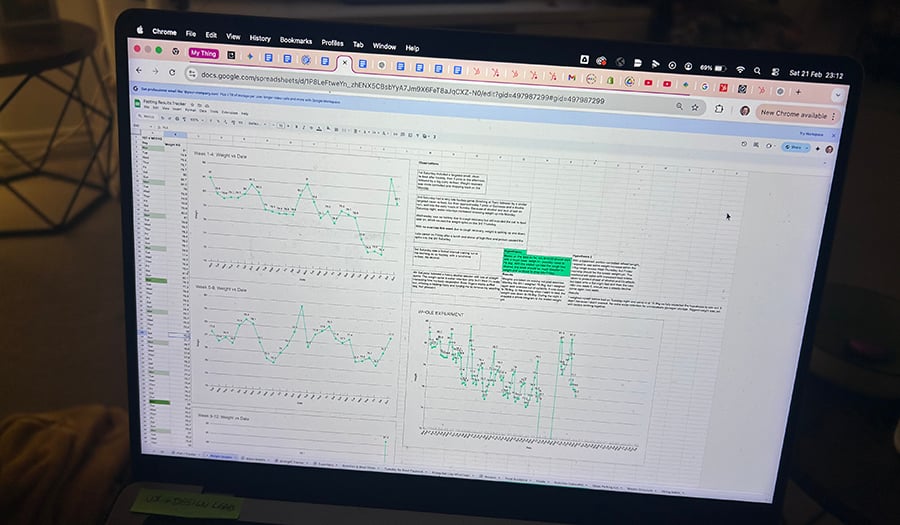
By profession, I work in UX and Conversion Rate Optimisation. Website design and lead-generation disciplines built on testing assumptions, measuring outcomes, and refining systems.
So I treated my nutrition and training the same way.
Variables tracked included:
- Fasted vs fed sessions
- Protein anchoring in first meals
- Carbohydrate placement relative to intensity
- Sodium timing before runs and lifts
- Sleep response
- Morning scale trends
- Waist and relaxed abdominal measurements
On a plant-based framework, protein timing became particularly important. Not increasing total intake wildly, but structuring it with more precision.
It’s very easy to overeat fibre on a whole-food vegan diet built around legumes and vegetables, so the goal was absolutely not to eat more.
But instead, to eat more deliberately.
Read more on how well-planned plant-based diets do not compromise athletic performance compared with omnivorous diets.
Early Results
Within structured guardrails, patterns began to emerge.
- Fasted evening runs improved in pace, including breaking the 27-minute barrier for a 5.5km equivalent effort (which included being able to run effectively without the need for my inhaler which I’d been on for light asthma since after Covid).
- Strength sessions progressed despite being performed in a fasted state.
- Importantly, recovery capacity didn’t collapse, which is often the hidden failure point of extended fasting.
- Respiratory control (and recovery) during high-intensity efforts improved.
- Late-night “false hunger” reduced when sodium and protein were positioned correctly.
Not every session improved. That’s important. But the trend was clear:
Fasted training did not suppress performance.
When structured correctly, including deliberate plant-based (vegan) protein placement from sources like tofu and legumes, with sodium management, it enhanced metabolic efficiency without sacrificing output.
“Scientific evidence suggests intermittent fasting does not negatively affect athletic performance metrics and may support recovery and body composition improvements.” (Source: Nutrients systematic review)
The Structure I Was Missing Before
What I discovered during my experiment was that fasting plus performance is not about eating less.
It’s about:
- When you eat.
- What you anchor first.
- How sodium is managed.
- Which sessions should remain fasted, and which should not.
- And that eating before some training sessions is ok.
- How recovery is protected.
- How sleep responds.
The full structure I have tested, including sodium strategy, protein hierarchy within plant-based meals, and my refeed sequencing, forms part of the broader framework explored in the book.
So, Can You Improve Athletic Performance While Intermittent Fasting Beyond 20:4?
Yes. But not accidentally.
And not by copying someone else’s fasting window from social media.
It requires:
- Consistency.
- Measured experimentation.
- Respect for recovery.
- An understanding that what works for one disciplined plant-based athlete may not work for another.
The goal is to understand how your physiology responds when variables are controlled.
That’s the work.
And that’s the journey this experiment continues to explore.
.png?width=185&height=185&name=Chris%20Dunkerley%20logo%202026%20(1).png)



Comments