The default assumption in sport is simple.
If you want to perform well, you need to eat regularly.
Athletes are often encouraged to fuel constantly. Breakfast, snacks, recovery drinks, energy gels and carbohydrate loading all reinforce the same message. Energy in, must match energy out.
For many people, that advice works.
But what happens when the body becomes properly adapted to fasting?
Key insight
Performance does not always require constant feeding. When the body becomes metabolically flexible through structured fasting and training, it can draw more efficiently on stored energy. This may improve endurance stability, respiratory efficiency and recovery between efforts.
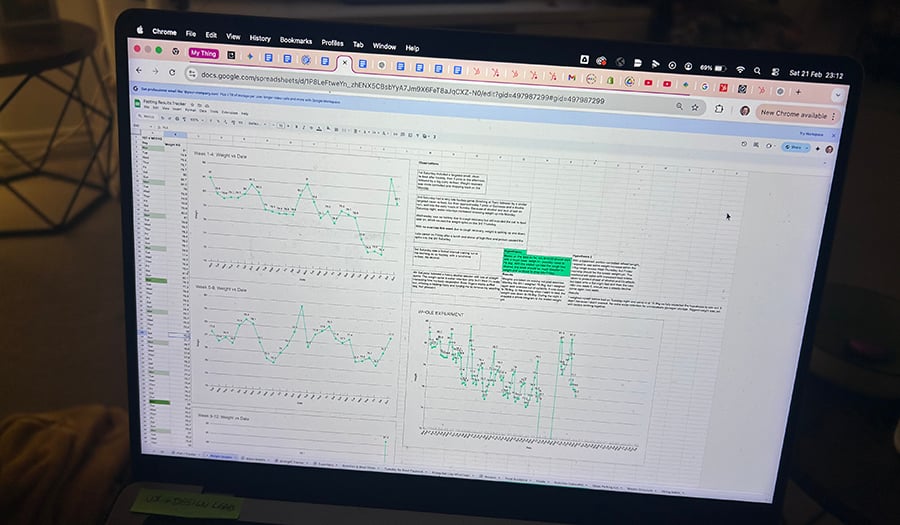
Over the past several months (since November 2025), I have been running a structured fasting experiment combining intermittent fasting, plant-based nutrition and consistent training. What began as a curiosity around advancing my metabolic adaptation, has gradually turned into something far more interesting.
Not only has performance improved, but in several areas it has improved while training inside fasting windows.
That outcome initially surprised me.
The Assumption Most People Start With
When people first hear about exercising while fasting, the reaction is usually the same.
-
Energy will crash.
-
Muscle will be lost.
-
Training quality will drop.
At a glance those concerns appear logical. If food is the primary fuel source for physical activity, then removing food should reduce performance.
Yet the human body is more adaptable than that.
The metabolic system is not designed to rely on one fuel source alone. It constantly shifts between stored glycogen, circulating glucose and stored body fat depending on availability and demand. (This is not something I knew when I started this experiment, but something I learned along the way).
The question is not whether the body can do this.
But how efficiently can it switch between those systems?
Early Adaptation Versus Deeper Adaptation
Many people experimenting with intermittent fasting are familiar with the early stages of fat adaptation.
Around eleven hours into a fasting window the body typically begins shifting towards increased fat oxidation. For people new to fasting this is often where the noticeable benefits appear. Mental clarity improves, appetite settles and energy levels become more stable.
For most casual fasters operating in an around the 16:8 (off:on) eating windows, this is where the exploration ends and the process repeats.
But extending that process further while maintaining consistent training appears to reveal additional adaptations.
For me, I have seen and recorded;
-
Improvements in respiratory efficiency.
-
Improvements in energy stability.
-
Advancements in cardio and strength performance.
-
Faster recovery between efforts.
These changes do not arrive overnight. They emerge gradually through repetition.
Observations From The Current Experiment
During the early stages of this experiment I expected some compromise in performance during fasted training. And in fact, my performance had already plateaued before starting.
However, once I corrected the errors and established a better structure, the opposite began to appear.
Fasted runs became progressively easier to sustain. Breathing settled more quickly during difficult sections of a route. Recovery between hockey sprints improved.
Strength training also continued to progress despite regularly lifting in extended fasting windows (48hrs off) and separately, up to 6-7hrs before eating.
Recently that progress became visible in a very clear way.
A long standing benchmark route of 5.7 kilometres that had resisted improvement for months was finally broken (today 9th March 2026). The run dropped to 26:16, smashing the twenty seven minute barrier and established several new personal bests across different segments of the route. (Data tracked on Strava.
This was not achieved during a heavily fuelled training session, but at 10 hours into a 48 hour fasting window.
At the same time, other changes have appeared.
-
Breathing during exercise feels more controlled.
-
Recovery between sprints has improved.
-
Even my inhaler use has quietly disappeared from my routine. (I don’t know for sure what single component of my routine has led to this, but it aligns with a combination of intake optimisations and sodium management changes).
None of this was expected at the beginning of the experiment.
A Possible Metabolic Explanation
The purpose of this experiment is observation rather than clinical proof, but several physiological explanations appear plausible.
When the body becomes accustomed to switching between glycogen and fat as fuel sources, energy availability becomes more stable. Instead of relying heavily on incoming food, the body learns to draw more effectively from stored energy.
That flexibility appears to reduce the dramatic peaks and troughs that some athletes experience when fuelling constantly.
At the same time, endurance systems appear to benefit from repeated exposure to lower glycogen environments. The body gradually improves its ability to preserve glycogen while drawing additional energy from fat oxidation.
Over time this may support more stable output across longer efforts.
These are not new ideas in sports physiology, but they are rarely explored within the context of plant-based nutrition and structured fasting routines.
The Guardrails Matter
It is important to emphasise that none of these improvements are occurring in isolation.
Fasting alone is not responsible for improved performance. The combination of disciplined eating, thoughtful meal timing and consistent training appears to be what allows the body to adapt - it’s certainly what my data shows.
Within the experiment there are also specific guardrails that support performance. These include careful attention to refeeding meals, sodium intake and the timing (and type) of carbohydrate replenishment around higher intensity sessions.
The details of that framework is what makes up the base of my writing in the book Beyond 20:4 (in progress).
Performance Without Constant Feeding
One of the more interesting realisations from this process is that frequent eating is not always the same thing as effective fuelling.
For some athletes, constant snacking may simply prevent the body from fully adapting to its own internal energy reserves.
When the body becomes confident drawing from those reserves, the need for constant feeding appears to reduce.
That does not mean food becomes less important. Far from it.
It simply means that when food does arrive, it can be structured more deliberately to support training, recovery and metabolic flexibility.
A Shift in Perspective
For years the common narrative around fasting has focused on weight loss.
Yet what this experiment is gradually revealing is something slightly different.
When structured carefully, fasting can coexist with improving physical performance - and the real insight and key component for me, is that I can do it on a clean, whole plant-based diet. Not something people typically write about.
The key to unlocking success, appears to be consistency and patience.
Frustratingly, metabolic adaptation and training progression both take time. Visible results often arrive long after the underlying physiological changes have already begun.
This experiment continues to explore what happens when those processes are allowed to develop together.
*Photo by engin akyurt on Unsplash
.png?width=185&height=185&name=Chris%20Dunkerley%20logo%202026%20(1).png)




Comments